Mini Split Cost to Install: What Drives the Price
What drives mini split installation cost: zones, line runs, electrical work, refrigerant labor and permits, explained with DOE and ENERGY STAR sources.


Ask "how much to put in a mini split?" and you'll hear wildly different numbers, and they can all be honest. The installed price is the sum of separate jobs: the equipment, the number of heads, the line run, the electrical work, the refrigerant labor and the permits. We don't invent a national average here. We show you which line items move a quote, with DOE and ENERGY STAR as sources, so you can compare proposals line by line.
Affiliate disclosureAs an Amazon Associate we earn from qualifying purchases made through links on this page. Commissions never change our ratings.
Why is there no single installed price?
Short answer The cost to install a mini split depends on how many indoor heads you need, how far and how visibly the line set must run, what electrical work your panel needs and who handles the refrigerant work. The U.S. Department of Energy says installing minisplits can be more expensive than some other systems, so compare itemized quotes rather than a single headline figure.
DOE Energy Saver lists higher installation cost as the first disadvantage of ductless minisplit heat pumps, and immediately adds that lower operating costs and available rebates or financial incentives can help offset the initial expense. That framing is the useful one: the purchase price of a carton is only one part of a project whose remaining parts are labor, materials and local requirements.
Prices quoted online also mix very different scopes. A single wall-mounted head next to an exterior wall is a different project from a whole-home layout with several heads in a multi-zone system. Before comparing totals, make sure two quotes describe the same rooms, the same capacity and the same exclusions.
- Equipment: outdoor unit, indoor head or heads, and the exact matched combination behind the efficiency rating.
- Installation labor: mounting, routing the conduit, drainage, refrigerant work and commissioning.
- Electrical: supply, disconnect and any panel changes, assigned to a licensed electrician.
- Local requirements: permits and inspections where your jurisdiction requires them.
- Incentives: rebates or credits that may reduce the net cost, checked for current eligibility.
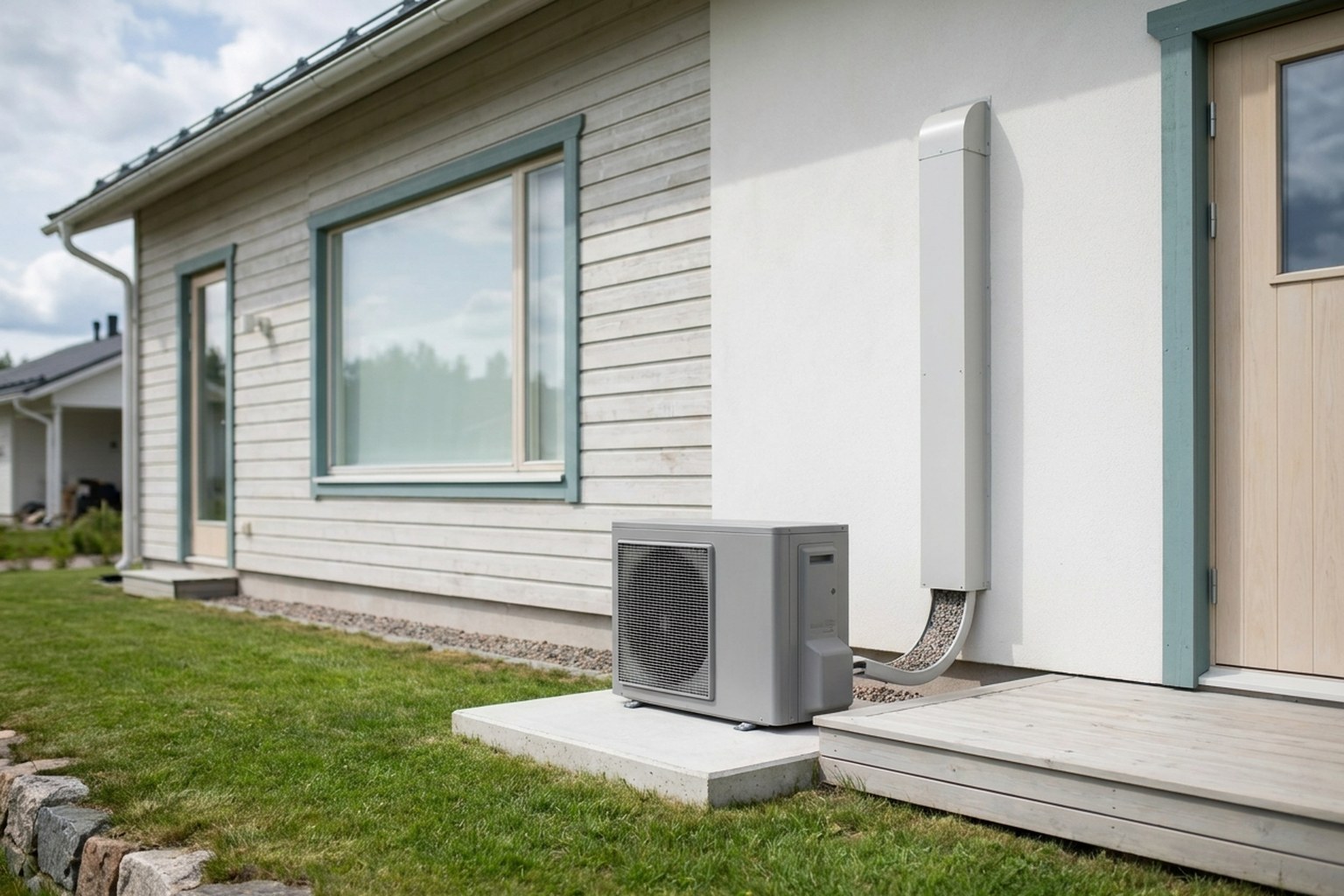
The cost drivers that change a quote
The DOE description of how a minisplit works explains why routing matters. The outdoor compressor/condenser and the indoor air-handling unit are linked by a conduit that houses the power cable, refrigerant tubing, suction tubing and a condensate drain. Every extra foot of that conduit, every wall it crosses and every cover used to hide it is part of the installed price.
DOE also notes that the connection generally requires only a three-inch hole through a wall for the conduit, and that the outdoor unit can be located up to 50 feet away from the indoor evaporator. Those are maximum flexibilities, not defaults: a longer or more hidden route is a design choice that a contractor will price.
| Cost driver | What changes the price | Source basis |
|---|---|---|
| Number of indoor heads | Each zone adds a head, a line route and a drain; DOE notes many models support up to four indoor units on one outdoor unit | DOE Energy Saver |
| Line route length and visibility | Outdoor unit can sit up to 50 feet from the indoor unit; longer or concealed routes add labor and materials | DOE Energy Saver |
| Sizing | An oversized system is more expensive to buy and operate | DOE Energy Saver; PNNL |
| Controls | Some makes require the manufacturer's own thermostat, which can be costly | PNNL |
| Refrigerant work | Charging must be done by an EPA certified technician | PNNL |
| Condensate drainage | There must be a place to drain condensate water outdoors | DOE Energy Saver |
If you are still deciding capacity, read mini split sizing and load calculations before asking for prices; a quote built on the wrong capacity is not a useful comparison.
How zones and head count change the total
The single biggest scope decision is how many rooms receive their own indoor unit. DOE explains that each zone has its own thermostat, which allows you to condition only occupied spaces. The trade-off is that every additional head brings its own mounting, its own section of line set and its own drain.
The DOE-funded Building America Solution Center, maintained by Pacific Northwest National Laboratory, adds a practical caution: it often does not make sense for an indoor unit to be installed in every single room, because of cost and because even the smallest indoor heads may provide much more heating or cooling than an individual space needs. A layout with fewer, well-placed heads can therefore be both cheaper and more appropriate than a head in every bedroom.
- Ask for the layout: request a drawing that shows each head, the outdoor unit and the line routes.
- Ask for the load basis: PNNL recommends ACCA Manual J load calculations for the spaces to be conditioned.
- Ask about unconditioned rooms: how will rooms without a head be kept comfortable?
- Compare like for like: two quotes with different head counts are two different projects.
Our comparison of 12,000 BTU mini splits and multi-zone systems lists documented capacity and configuration so you can bring exact model references to the conversation.

Electrical, refrigerant and permit line items
Three line items are often missing from low headline prices. The first is electrical work. Manufacturer instructions for DIY-marketed systems still state that wiring must comply with local and national electrical codes and be installed by a licensed electrician. Ask each quote to state whether the electrical supply and disconnect are included, and if not, get a separate estimate from a licensed electrician.
The second is refrigerant work. PNNL states that refrigerant charging must be done by an EPA certified technician, and EPA rules require certification for technicians who maintain, service, repair or dispose of equipment that could release refrigerants. A quote should say who performs that work. Our guide to questions to ask before installation lists the points to get in writing.
The third is local requirements. Permits and inspections vary by jurisdiction, so the reliable approach is to ask the installer which permits apply and whether their price includes them.
- Electrical: included, excluded, or quoted separately by a licensed electrician?
- Refrigerant: performed by an EPA-certified technician named in the proposal?
- Permits: who applies, who pays, and is an inspection included?
- Commissioning: PNNL recommends checking the system in all modes; is that in scope?
Operating cost, incentives and the long-run picture
Installation cost is only half of the money question. ENERGY STAR notes that a typical household energy bill is around $1,900 a year and that almost half of it goes to heating and cooling. Its consumer fact sheet adds that certified mini splits cool directly from the unit rather than through ductwork, eliminating duct energy losses that can account for more than 30% of a home's energy use for space conditioning.
Incentives change over time, so check them on the date you buy. The ENERGY STAR tax-credit page we fetched describes a credit of 30% of project cost up to $2,000 and states that it was effective for products purchased and installed between January 1, 2023, and December 31, 2025. Treat that as a historical reference and confirm current federal, state and utility programs before relying on any incentive. DOE points to the ENERGY STAR Home Improvement Savings tool for local offers.
| Figure | What it says | Status |
|---|---|---|
| Around $1,900 a year | Typical household energy bill (ENERGY STAR) | National average, not your bill |
| More than 30% | Share of space-conditioning energy that duct losses can account for | Applies when ducts are in unconditioned space |
| 30% up to $2,000 | Federal credit described on the ENERGY STAR page | Stated window ended December 31, 2025 |
How to compare installation quotes
Once you have two or three proposals, put them into the same format. The goal is not to find the cheapest number but to find the proposal whose scope matches your house and whose exclusions you understand. Our mini split buying framework suggests keeping a written decision record; the same approach works for quotes.
- Same capacity and heads: identical model numbers or clearly equivalent matched combinations.
- Same route: line lengths, covers and wall penetrations described the same way.
- Same exclusions: electrical, permits, drainage and patching listed explicitly.
- Same documentation: load calculation, warranty registration and commissioning record.
If you want to sanity-check capacity before the visit, our capacity planner converts units for communication only; it does not replace a load calculation. Then use the comparator pages to note exact model references, and let a qualified HVAC professional confirm what your home actually needs.
Our rated picks
The three best-rated models of our best mini splits in 2026 ranking, from the buyer review record and the listed specs.


Product images: Amazon listings
Sources and further reading
- U.S. DOE Energy Saver: Ductless Minisplit Heat Pumps (archived June 18, 2026)
- ENERGY STAR: Ductless Heating & Cooling (mini split heat pumps)
- ENERGY STAR: Consumer fact sheet for certified mini split heat pumps (2024, PDF)
- ENERGY STAR: Air Source Heat Pumps federal tax credit page
- PNNL Building America Solution Center: Ductless (Mini-Split) Heat Pumps (DOE-funded guide)
- Exact listing reference: YITAHOME 12000 BTU Mini Split AC/Heating System 115V 20 SEER2 (exact listing)